
How remote tank monitoring with pressure sensors work?
Why measure level in tanks ?
Whether you work in water supply, agriculture, industry, transportation or waste management – you probably have one or more tanks that stores liquids you depend on. It could be clean water, diesel, chemicals, sewage or other.
Knowing how much fuel is left in the tank isn't just practical – it's often critical. Without accurate information, you could risk:
Downtime due to empty tanks
Flooding because the tank is full
Unnecessary inspections and manual checking
Wrong order or delayed logistics
Traditional methods such as manual surveying or visual gauges often provide inaccurate or incomplete data – especially in confined or difficult-to-access areas. tanks In addition, it costs time and resources.
That's why more and more people have switched to digital solutions - and among the most reliable and flexible methods we find tank monitoring with a pressure sensor . But how does it actually work?
What is tank monitoring ?
Tank monitoring means that you measure the level in a tank without being physically present – preferably using sensors that send data to a cloud platform. This makes it possible to monitor in real time, receive alerts and take action before the tank is empty or full.
What is a pressure sensor and how does it work?
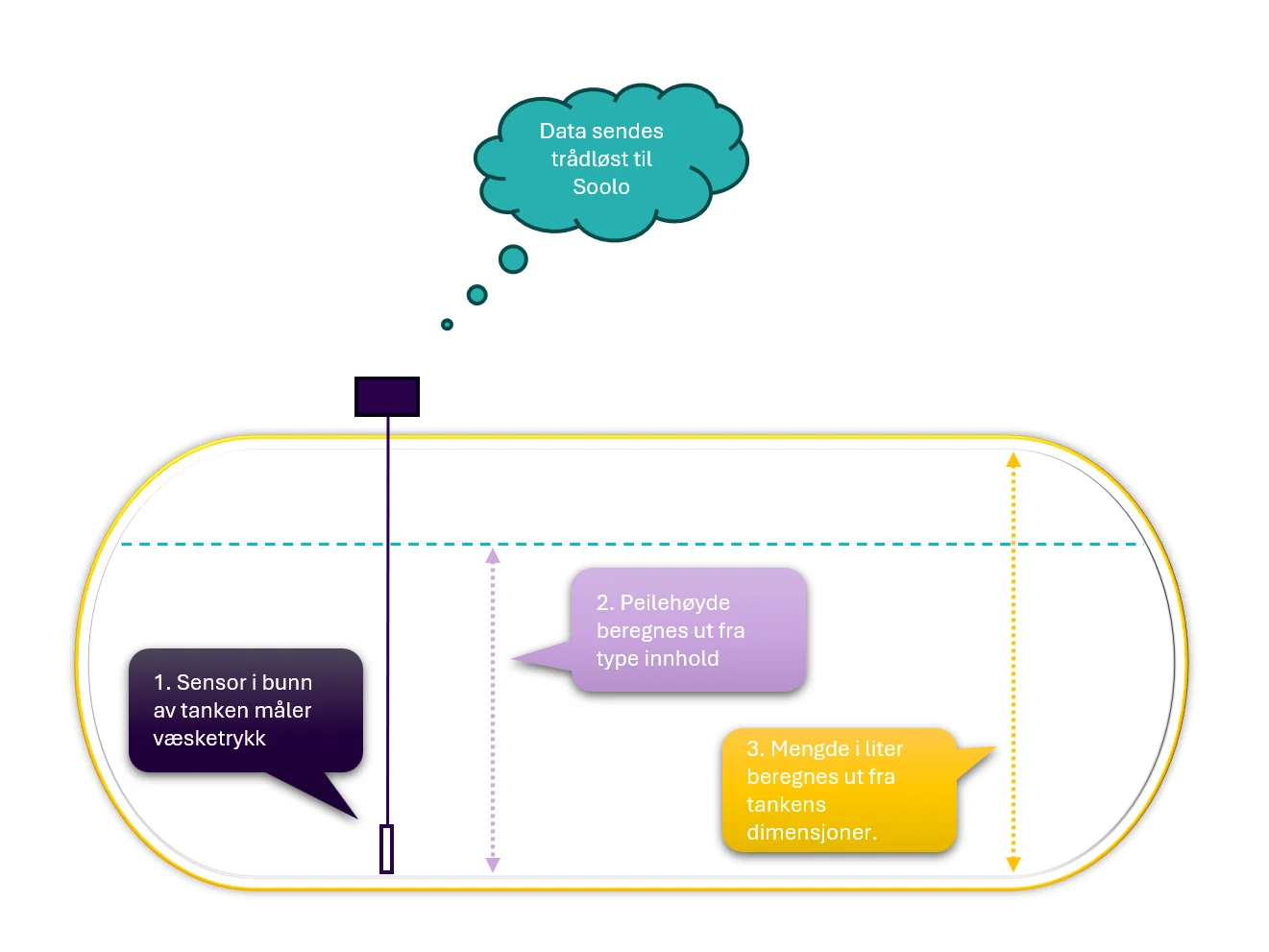
A pressure sensor detects the hydrostatic pressure exerted by the liquid in a tank. The higher the liquid level, the higher the pressure at the bottom. The sensor converts this pressure into an electrical signal, which is interpreted as the liquid level and volume.
Step by step: How remote sensing works
The sensor registers the pressure at the bottom of the tank.
Data is converted to liquid level and volume via a formula adapted to the tank shape and liquid type.
The signal is sent wirelessly to an IoT device.
The data is uploaded to the cloud and displayed in an app or on the web.
The user gets real-time overview , history and notifications.
What are the advantages of this method?
- Precise measurement - regardless of tank design
- Easy installation – often without opening the tank
- Wireless and maintenance-friendly
- High/low level alert
- Remote monitoring via mobile and PC
Typical applications
Tank monitoring with pressure sensor is suitable for:
Diesel tanks on farms and construction sites
Water tanks in cabins or waterworks
Chemical containers in industry
- Sludge- and septic tanks
How Soolo makes it easy
- Robust pressure sensor
- Wireless device with long battery life
- Cloud-based dashboard with live data, history and notifications
- Adapted to different applications and fluid types