
HVO costs 6 kroner more per liter – what does that mean for your company?
HVO costs 6 kroner more per liter. What does that mean for your business?
More and more of our customers are choosing HVO 100 over fossil diesel. Contractors who will deliver on fossil-free construction sites. Transporters who want to reduce emissions. Fuel suppliers who are noticing increased demand from environmentally conscious customers.
The transition makes sense. HVO can reduce CO₂ emissions by up to 90 percent compared to fossil diesel, depending on the feedstock and calculation method. At the same time, existing machines can continue to be used. HVO is compatible with most modern diesel engines that meet EN 15940, is available in winter grades down to -30 °C and does not require any special tanks .
The biggest difference, however, is one thing: the price .
HVO 100: NOK 22.50 per liter
As of January 2026, HVO 100 is around NOK 22.50 per liter, compared to approximately NOK 16.40 for regular diesel (bulk list prices, incl. VAT). This corresponds to around 37 percent higher fuel costs.
For a contractor with 50 construction machines that collectively use 500 liters of fuel per week, this means approximately NOK 7.8 million more in annual fuel costs.
As fuel becomes more expensive, every liter that is wasted, stolen or lost also becomes far more costly than before.
Three challenges HVO users face
1. Waste costs more than before
On plants and projects, fuel disappears for various reasons: idling, overfilling, small leaks that go undetected – or, in the worst case, theft.
If 1,000 liters of HVO are lost during a project, it equates to NOK 22,500 in pure fuel costs. In addition, there is downtime, extra work and frustration.
2. You can't always fill where it fits
HVO is not as readily available as fossil diesel. Many companies rely on scheduled deliveries with longer lead times. If your tank runs out, you risk having to refill with fossil diesel – or stop operations altogether.
When Sweden lowered the blending requirement for biofuels in January 2024, many companies suddenly experienced a shortage of HVO at short notice. Good oversight of consumption and stock levels became critical.
3. Use must be documented
Documentation requirements are increasing. Public tenders require fossil-free operation. Developers want to see how much HVO is actually used on the project. Eco-Lighthouse-certified businesses must report the proportion of biofuels in their annual report.
It's no longer enough to say you use HVO. You need to be able to document it – with numbers.
HVO in the Nordics: Three countries, three markets



The market for HVO varies significantly in the Nordic region.
Norway has strict requirements. The turnover requirement for biofuels was 19 percent for road traffic and 10 percent for construction diesel in 2025, with a further increase in 2026. HVO is already mixed into most of the diesel at the pumps. At the same time, many municipalities require fossil-free construction sites – Oslo has had this in its tenders since 2017. The price of HVO 100 is around 37 percent above fossil diesel, without special tax breaks.
Sweden was a long-time leader. After the blending requirement was lowered to the EU minimum in 2024, the HVO share in regular diesel fell sharply. At the same time, the voluntary purchase of pure HVO 100 increased. In the first quarter of 2025, HVO 100 accounted for a full 7 percent of fuel deliveries, according to Drivkraft Sverige. Tax exemptions mean that the price difference is often lower than in Norway.
Denmark lags behind. Limited availability and lack of tax exemptions make HVO expensive. Its use is mainly driven by public tenders and some environmentally ambitious businesses.
What happens next?
Analyst firm Argus points out that demand for HVO will likely exceed supply in the coming years. The IEA has also warned of possible raw material shortages, particularly for fats and oils used in production, towards 2027.
For the Nordic region, developments are going in two directions. Electrification is accelerating for passenger cars, vans and city buses. At the same time, heavy transport, construction machinery and agriculture are more difficult to electrify.
Here, HVO will likely be an important transitional fuel for many years to come. Volvo Trucks refers to HVO precisely as a transitional fuel, while battery and hydrogen technology matures for heavier vehicles.
For those of you who use HVO today, this means two things:
- Prices will likely remain high – perhaps even increase
- Documentation requirements will become stricter
Both make control of consumption and inventory levels more important than ever.
Tank monitoring for HVO users
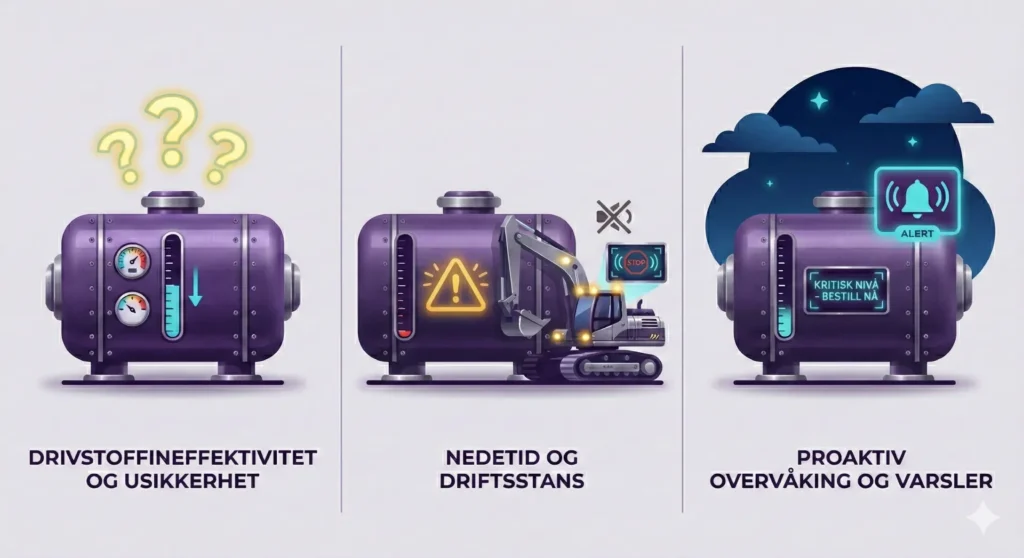
Our sensors do the same for HVO as they do for diesel: measure levels in real time, alert when levels are low, and log consumption over time. The difference is that the value increases when the fuel is more expensive.
Cost control : Compare actual consumption between projects. When project A uses 30 percent more HVO than project B on a similar job, you have a basis for finding the cause – idle time, incorrect use or leakage.
Alert before the tank is empty : The system alerts both you and the supplier when the level reaches a defined limit. You avoid panic orders, rush deliveries and downtime.
Burglar alarm : A sudden drop in the level of 500 liters in the middle of the night triggers an alarm. You will be notified immediately – not the next day.
Documentation for climate accounting : Get reports that show accurate consumption over time. Combine with the supplier's sustainability certificates and correct emission factors, and you have the numbers you need for the developer, auditor or the Environmental Lighthouse.
The value of knowing – also for HVO
HVO users are often environmentally conscious businesses. They have chosen a more expensive fuel to reduce emissions. This also comes with requirements for documentation and control – while margins are often small.
For these customers, the value of knowing is about:
- Actual dollars saved
- Climate accounting that meets targets
- Deliveries that arrive on time