
Fuel preparedness in Norway: Do we really have an overview of the stocks?
A new report from FFI shines a spotlight on fuel preparedness in Norway . We have stocks and preparedness requirements, but lack an overview of what is actually out there.
On March 5, 2026, the Norwegian Defence Research Institute published the report National Supply Security in Crisis and War. 138 pages of analysis of what happens to our food and fuel supply if supply chains collapse. Commissioned by the Ministry of Trade, Industry and Fisheries. Written by researchers who have studied the Ukraine war, NATO requirements and Norwegian supply chains closely.
The report tells a story we should listen to.
Fuel consumption and emergency response figures in Norway
Norway uses around 3.6 billion liters of diesel per year, according to the latest sales statistics from Statistics Norway. About 10 million liters every single day. We have one refinery, Mongstad, and 80 percent of what is produced there is exported. We import the rest from increasingly distant countries, after the sanctions against Russia significantly extended supply chains.
20 days
Emergency stock requirement for fuel in Norway.
FFI report 26/010, chapter 3.4.2 / Act on emergency storage of petroleum products
20 days of stock may sound sufficient. The problem is that the requirement applies nationally, as an average. No one has a real-time overview of the actual distribution. Does Nordland have 5 days and Østlandet 30? Or vice versa? FFI points out exactly this: We lack a common situational picture.
At the same time, NATO is planning for 100,000 allied forces to be able to mobilize to Norway within 10 days, with up to 500,000 within 180 days. These forces need fuel. A lot of fuel. And it will have to come from a country that already imports diesel to meet its own peacetime needs.
Norwegian fuel readiness depends on few terminals
Norway's fuel distribution system is based on 15 main terminals along the coast, from Fredrikstad to Alta. Each terminal covers an area of 100 to 150 kilometers. From there, tanker trucks travel to gas stations, construction sites, farms and emergency services.
FFI describes this as a vulnerable structure. "Just-in-time" logistics have reduced readiness margins. Stocks are smaller than before. And outside the terminals — out at the thousands of end users — there is no systematic overview of what is left in the tanks.
"Common data standards for inventory status, bottlenecks and risk indicators that allow actors to exchange information faster and more accurately."
FFI report 26/010, recommended measures for information sharing
What the report calls for is not just storage. It's information. Who has what, and where.
Electrification changes fuel readiness requirements
Here lies a paradox that the FFI report highlights well. Norway's fossil fuel share is falling. Sales of gasoline and diesel are down over 30 percent since 2010. Almost 95 percent of new cars are electric.
But those who still need fossil energy are precisely those we cannot do without in a crisis: the military. Emergency services. Construction sites. Agriculture. Emergency power generators in hospitals and data centers. Fishing vessels.
As the civilian volume shrinks, so does the commercial market that supplies these users. Military needs become more distinct and less integrated with civilian markets, as the FFI puts it. The consequence is that the gap between peacetime consumption and wartime needs grows. With that, the risk of demand shocks also grows.
Production and import
Norway has only one refinery (Mongstad). 80% of production is exported. Diesel is imported from increasingly distant countries.
FFI report 26/010, chapter 3.3.2
Distribution
15 terminals along the coast. Tanker radius 100 to 150 km. Transport infrastructure is a critical vulnerability, especially in the north.
FFI report 26/010, chapter 3.3.3
Changing consumption
The fossil fuel share falls from 63% (2005) to 46% (2023). The remaining users are more strategically important than ever.
FFI report 26/010, chapter 3.3.4 / Knoema 2024
New DSB role
In 2025, DSB was given responsibility for coordinating the mapping of vulnerabilities in supply chains and identifying shortage situations.
What systems exist for fuel preparedness in Norway?
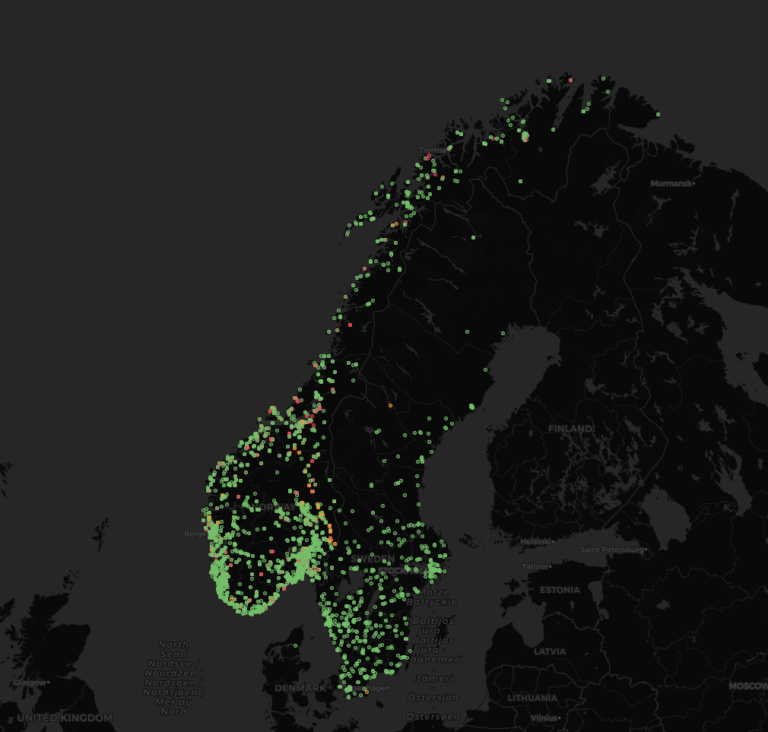
Soolo currently monitors over 3,500 fuel tanks in real time, all over Norway. 131 million liters of tank capacity. 170 corporate customers. Fuel suppliers, contractors, farms, municipalities. Sensors that measure filling levels, report consumption patterns and alert when levels are low.
The system was built for logistics. Customers use it to optimize replenishment routes and avoid empty tanks on construction sites in the middle of December. These are everyday problems.
But the data being collected is the same data FFI is calling for for preparedness: What is the fill rate right now? Where is consumption abnormally high? Which regions have critically low levels?
That infrastructure exists. It sends data around the clock, from tanks spread across the country. And it is built on a platform with an open API, designed for integration with other systems.
Fuel as critical infrastructure in Norwegian emergency preparedness
FFI recommends 15 prioritized measures. Among them: establishing emergency stocks, securing power access, strengthening information sharing and entering into civil-military emergency agreements. The report emphasizes that the measures must be developed in close cooperation between authorities and the business community.
Information sharing requires information. And information about distributed fuel, that which is located outside the 15 terminals and out at the end users, requires sensors in the field.
It doesn't require a new million-dollar project. It requires using what is already in operation.
The data from 3,500+ sensors can be anonymized and aggregated into regional contingency overviews without exposing individual customers' business data. A situational picture that shows distributed inventory status, consumption trends and deviations. Exactly the kind of information decision makers need to prioritize correctly.
The Ukraine experiences described by FFI show that fuel supplies are among the first to be affected in war. Attacks on power infrastructure create a double vulnerability: Without power, fuel distribution also stops. Backup power depends on diesel. And who knows how much diesel is in the emergency generators around the country?
Sensors know that.
Why fuel readiness in Norway is critical
The FFI report is not a warning that something might happen one day. It is a description of existing vulnerabilities. Structural weaknesses that are already there, and that will be greatly amplified in a crisis.
Real-time monitoring of distributed fuel reserves is not a new idea. There is existing technology, already in operation, that can contribute to the situational picture called for in the report.
The question is not whether we have the tools. The question is whether we choose to use them.